

Practise the conversations that shape veterinary care.
VEWAI helps veterinary learners develop communication skills through realistic roleplay, structured feedback and repeat practice. From foundational interactions to complex consultations, clinical reasoning comes into focus when the scenario calls for it.
Realistic roleplay · Specific feedback · Repeat practice
Choose a scenario. Have the conversation. Review the feedback. Try again.
“Awesome tool, user friendly and engaging.”
Why communication practice matters
In a study of 100 settled cases of alleged veterinary professional negligence involving canine patients, communication problems were identified in 80 cases.
The study examined communication with owners and within veterinary teams. It highlights the importance of practising these interactions; it does not evaluate VEWAI.
Communication is a clinical skill
It develops with practice
Veterinary learners need opportunities to ask questions, listen, explain, respond to emotion and work with colleagues. These skills develop through practice, feedback and reflection, from the first years of training onwards.
Practice before the pressure
Rehearse conversations before facing them in placements or practice.
Respond to realistic personas
Work through uncertainty, emotion and different perspectives, not just scripted answers.
Communication in clinical practice
In advanced scenarios, learners practise taking a history, explaining options and discussing a plan with an owner, while applying their clinical reasoning.
Realistic conversations. Useful feedback. Another chance to practise.
Learners interact with AI roleplay characters in educator-designed scenarios. They make choices, respond to what they hear and receive feedback they can use in their next attempt.
Your Learning Objectives. Your Choice of Scenarios.
Create scenarios tailored to your teaching, or choose from VEWAI's specialist-authored cases.
Create Your Own Scenarios
Build scenarios around the communication skills, topics and learning objectives you want your students to practise. Tailor the conversation to their stage of training and your curriculum. Use guided templates to create new cases for your students. The templates prompt you for the information needed to build a complete, realistic conversation—no previous experience in scenario creation required.
Use Specialist-Authored Cases
Choose ready-made clinical scenarios authored by veterinary specialists. These offer an additional practice resource, particularly for students in their final two years and during clinical rotations, or veterinary surgeons aiming to perfect their reasoning and communication skills or undergoing postgraduate clinical training (internship and residency).
Have the conversation
Engage with an owner or member of the veterinary team and respond as the interaction develops through spoken speech or text dialogue.
Review and repeat
See specific feedback structured around established communication frameworks, reflect on your approach and try again.
Specialist-Authored Scenarios
Clinical cases and background details are authored by veterinary specialists to reflect realistic practice.
Roleplay Characters
Learners interact with distinct owner profiles and clinical colleagues representing different communication challenges.
Spoken & Written Practice
Supports speech input and text dialogue, allowing learners to practise realistic spoken pacing.
Repeatable Practice
Learners can revisit cases at their own pace to test different approaches and apply feedback directly.
Communication practice that grows with the learner.
VEWAI brings communication skills together in realistic veterinary conversations. Educators can focus learning on individual skills or combine them within more demanding clinical consultations.
Foundations
Opening conversations, building rapport, listening, asking questions and explaining clearly.
Applied Conversations
Responding to concerns, exploring a client's perspective and discussing options.
Communication in Clinical Context
Bringing communication and clinical reasoning together to gather information, explain decisions and agree next steps.
We are developing additional activities for earlier years of veterinary school, allowing students to focus on communication with less emphasis on clinical knowledge.
Feedback learners can use. Insights educators can act on.
VEWAI turns a practice conversation into specific points for reflection. Educators can use patterns across learners to guide teaching and support.
For the Veterinary Learner
Immediate debrief after each conversation
- See what worked in the conversation.
- Identify a specific communication skill to improve.
- Try the scenario again and apply the feedback.
- For scenarios that assess clinical reasoning: Review diagnostic decision paths and investigation choices alongside communication feedback.
Feedback rubrics are informed by established clinical communication principles, including the Calgary–Cambridge guide.
For Veterinary Educators
Cohort feedback & teaching support
- See where learners are progressing or struggling.
- Use scenario results to focus teaching and discussion.
- Align practice with course learning objectives.
Student feedback on earlier-version testing
Verbatim feedback collected during a 2025 student evaluation of an earlier VEWAI prototype at the University of Nottingham.
“Awesome tool, user friendly and engaging.”
“I liked getting more information as you go along like in a real life case and that you had to ask specific questions in order to get the full picture.”
“Towards the end of the case I felt I was able to engage with it more and treat it as if it were a real scenario.”
These quotations represent selected feedback collected during a 2025 student evaluation of an earlier VEWAI version. They do not claim universal consensus or clinical outcome improvements. Full study findings and academic publications will be shared following formal peer review.
Better conversations start with meaningful practice.
Communication matters.
Listening, understanding and explaining clearly are essential veterinary skills. We put them at the heart of learning.
Improvement takes practice.
Students need opportunities to try, receive feedback, reflect and try again—building confidence before real consultations.
Learning should feel real.
Engaging, realistic conversations bring learning to life, helping students prepare for the human side of veterinary practice.
AI should support the learning process.
Learning happens through doing, thinking and reflecting. We believe AI should create opportunities for students to practise and receive feedback, while keeping them actively responsible for their own learning.
Conceived by Veterinary Clinical Educators
VewAI is created by European Veterinary Specialists and clinical educators with decades of university teaching and international specialist practice.
Following discussions with the relevant University of Nottingham teams, VEWAI is working towards formal spin-out status. Internal rollout and evaluation are the next steps towards formalisation, which remains subject to university approval.
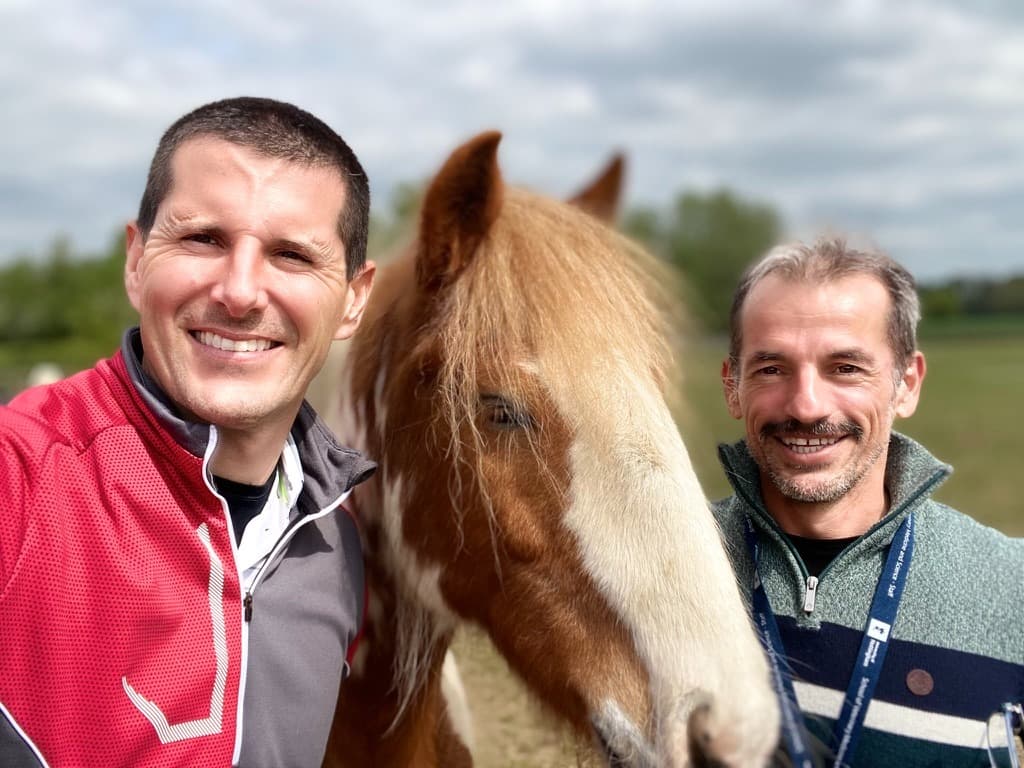
Marco (left) and Ignacio (right) with “Mango” (centre).
Marco and Ignacio have known each other for over 20 years, sharing a close friendship both at work and privately. Both have a natural knack for technology and educational innovation, united by the conviction that AI offers enormous potential to support veterinary teaching and clinical learning.
* Mango is not directly involved in VEWAI, having shown a firm preference for real rather than simulated carrots.
Dr. Marco Duz
Co-Founder & Clinical LeadMedVet MVM(Res) PhD DipECEIM RCVS Specialist SFHEA
Clinical Associate Professor in Equine Internal Medicine
Clinical Associate Professor at the University of Nottingham. EBVS® European and RCVS Recognised Specialist in Equine Internal Medicine, Senior Fellow of the Higher Education Academy (SFHEA), and Treasurer of the ECEIM Executive Committee, with over 20 years of clinical and university educational experience worldwide.
Dr. Ignacio Corradini
Co-Founder & AI Educational StrategyMV MSc PhD DipECEIM RCVS Specialist FHEA
Clinical Assistant Professor in Equine Internal Medicine
Clinical Assistant Professor in Equine Internal Medicine at the University of Nottingham. EBVS® European and RCVS Recognised Specialist in Equine Internal Medicine, Fellow of the Higher Education Academy (FHEA), and Chair of the School's Digital Learning Group, pioneering AI integration and clinical simulation.
Engineering & Technical Development
Dr. Sebastian Corradini
Technical Lead
Medical Doctor and certified AI developer specializing in clinical simulation architecture and healthcare NLP.
Nick Coleman
Senior Full-Stack Developer
Lead platform engineer architecting responsive interactive interfaces, database infrastructure, and pedagogical scoring modules.
Designed to minimise personal information
Students verify their university affiliation by email, then create a separate username and password. VEWAI does not retain their verification email address or require their real name. Their year of study determines which learning resources they can access.
Audio recordings and conversation transcripts are not retained. Feedback is accessible only to the individual student, allowing them to review their practice and track their progress while their account remains active, up to graduation.
VEWAI LTD is registered with the Information Commissioner’s Office. Registration reference: ZB996913.
Bring VEWAI to your veterinary school.
Tell us about your teaching needs and we'll discuss how VEWAI could support your learners, including current pilot opportunities.